blog-id



Guangzhou is a trade hub in southern China, and its clothing wholesale districts are one of the operational nodes of the global apparel supply chain. The markets here cover almost every category buyers can name—high-end brands, affordable fast fashion, original designer brands, and export surplus—and attract buyers, retailers, and fashion professionals from across the country and around the world.
This guide selects the fifteen markets most often recommended to first-time visitors, reorganizes them by the districts you will actually walk through, and provides each building with opening hours, metro exits, floor distribution, and category structure. Below is an honest breakdown of "which district suits which type of buyer."
Which market is right for you — at a glance
| Market area | Best for | Opening rhythm | Suits a brand owner? |
| Station front (站前路 / 站南路 / 环市西路) | Mid-to-high-end womenswear and menswear, original designer brands, export apparel, denim | Mostly 8:30–18:00; Yima until 19:00 | Partly — the best area for fit, quality and price benchmarking |
| Zhanxi Road (站西路) | Korean and Japanese trend-led styles, designer brands, factory-direct casual wear | 10:00–18:00, the late-shift cluster | Partly — trend reading and reference, not development |
| Shisanhang (十三行) | Fast-fashion womenswear, trend styles, accessories and bottoms | 7:00–16:00, trade starts at dawn | No — trends only, no development |
| Shahe (沙河) | Denim, trousers, low-end adult and children's basics at volume | 7:00–17:00, a morning market | No — price-led, with thin quality control |
| Zhongshan 8th Road (中山八路) | Childrenswear, maternity and infant products, children's shoes and accessories | 8:30–18:00 | Yes if you are building a kids' line — it is the specialist area |
| Shijing, Baiyun (石井 / 白云) | Brand discount clothing and tail goods, by zone and by season | 9:00–18:00 | No — leftovers, not a supply chain |
Market name lookup — every building, by area
Most buyers hear the buildings by name long before they hear the areas. This table maps the fifteen names to the six areas covered below, so a name on a supplier's card can be turned into a route.
| Market | Area | Known for | Suits a brand owner? |
| Guangzhou Baima Clothing Wholesale Market (广州白马服装市场) | Station front | Opened 1993, 60,000 m²; mid-to-high-end mature womenswear and menswear | Partly — the benchmark for fit and price |
| Guangzhou Liuhua Fashion Wholesale Market (广州流花批发市场) | Station front | One of the earliest foreign-trade apparel markets; 30,000 m²; exports to 100+ countries | Partly — export-oriented one-stop procurement |
| Hongmian International Fashion City (红棉国际时装城) | Station front | 60,000 m², 1,800+ merchants; mid-to-high-end trend clothing and original designer brands | Partly — a good place to compare branded quality |
| Yima Clothing Wholesale Plaza (广州壹马服装广场) | Station front | Korean ins-style womenswear downstairs, casual business menswear above, live-stream base on floor 10 | Partly — a good first stop to read the area |
| Guangzhou World Trade Clothing City / apM Times (广州APM世贸服装城) | Station front | 280,000 m²; original menswear and womenswear, shoes, accessories and luggage | Partly — read the lookalike warning before buying anything with a logo |
| Guangzhou Changjiang International Fashion City (广州长江国际服装城) | Station front | Denim on floors 1–2; floors 3–7 are foreign-trade offices open by appointment | Partly — go for denim, book ahead for the offices |
| Huimei International Clothes City (汇美国际时装城) | Zhanxi Road | 400 designer womenswear brands on floors 1–2, high-end designers on 3, menswear on 4–5 | Partly — strong for trend and design reference |
| Guangzhou UUS International Fashion City (广州UUS国际时装城) | Zhanxi Road | Nine floors of Korean-style womenswear (1–4) and menswear (5–8); the "Chinese Dongdaemun" | Partly — pick one of Huimei or UUS and go deep |
| Zhanxi Clothing Wholesale Market (站西服装批发城) | Zhanxi Road | Factory-direct low-to-mid-range casual wear, denim shirts and knit sweatshirts; founded 1992 | Partly — factory direct, but see the compliance warning |
| Shisanhang Clothes Wholesale Market (广州十三行服装批发市场) | Shisanhang | Japanese and Korean magazine styles; low-end on floors 2–3, mid-to-high-end on 4–6 | No — trends only, no development |
| Wanjia Clothes Wholesale Plaza (万佳服装批发广场) | Shahe | 50,000 m², 2,500+ shops; one of South China's most professional denim distribution centres | No — price-led |
| Guangzhou South City Clothing Market (广州南城服装批发市场) | Shahe | Trousers, skirts and denim; cheaper than neighbouring Wanjia, best quality on floors 4–5 | No — price-led, but with better denim |
| Lihu Building (荔湖大厦) | Zhongshan 8th Road | Zhongba children's clothing and maternity/infant plaza; Japanese and Korean styles on floor 1 | Yes if you are building a kids' line |
| Li Shang Boutique Children's Wear Trade City (荔尚精品童装商贸城) | Zhongshan 8th Road | Three floors, 300+ shops of boutique childrenswear, shoes, bags and toys | Yes if you are building a kids' line |
| Guangzhou Jindong Garment Trade Center (广州锦东国际服装城) | Shijing, Baiyun | 100,000+ m², 3,000+ shops of brand discount clothing and tail goods in Areas A, B and C | No — stocklot only |
1. The station front area (站前路 / 站南路) — mid-to-high-end and export apparel
Addresses in this cluster sit on Zhannan Road, Huanshi West Road, Zhanqian 1st Street and Renmin North Road, across Yuexiu and Liwan districts. Guangzhou Railway Station on Metro Lines 2 and 5 is the anchor: exits G, D4 and H put most of these buildings within a short walk. Hours generally run from 8:30 to 18:00, with Yima open until 19:00. If you only have one day in Guangzhou, spend it here — it is the most organised cluster and the easiest to navigate without Chinese.
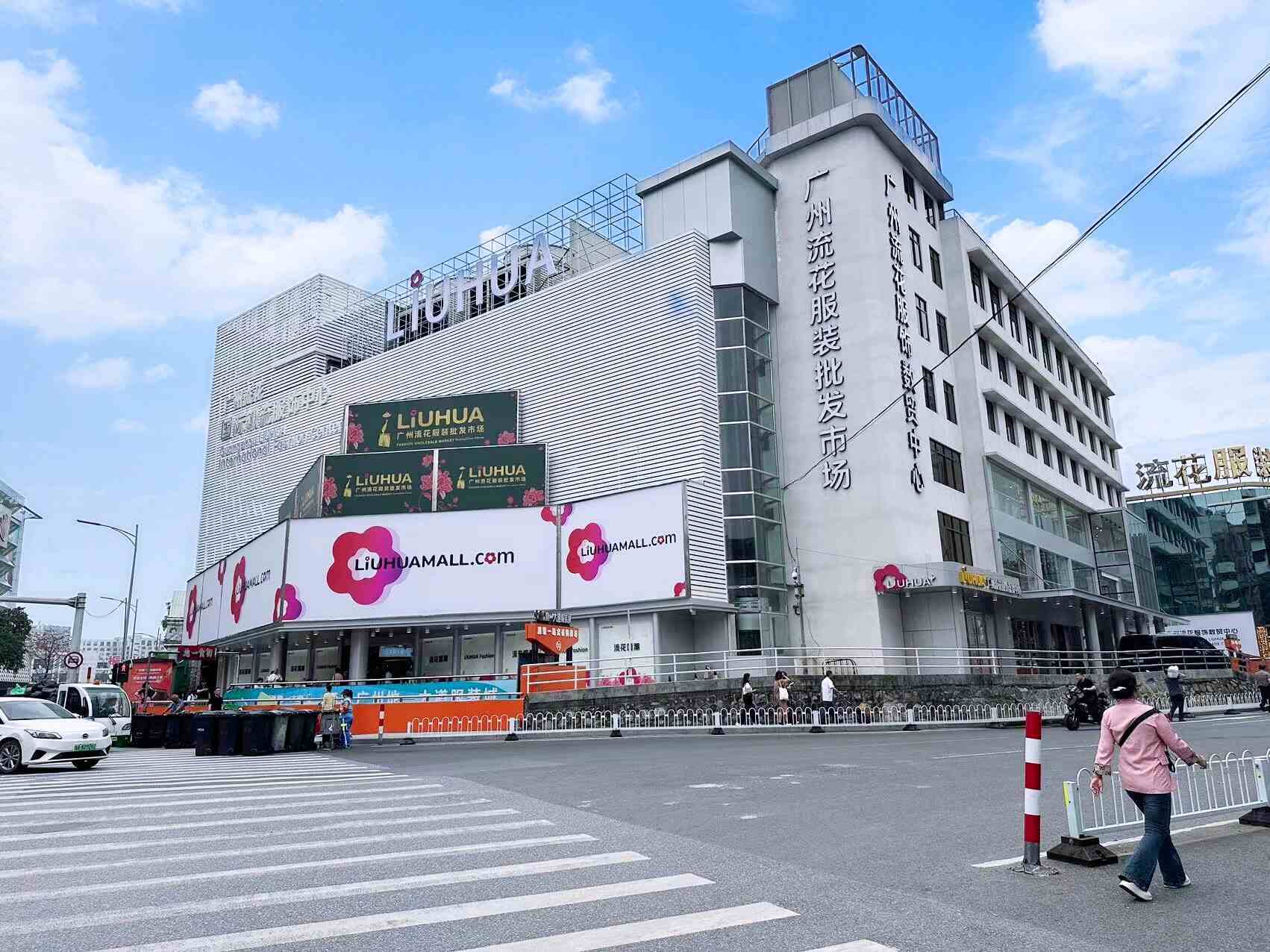
Guangzhou Liuhua Fashion Wholesale Market (广州流花批发市场)
Established in 1996 at No. 194 Huanshi West Road, Yuexiu District, right next to the railway station and close to the Canton Fair complex, spanning more than 30,000 m². It is one of the city's earliest specialised foreign-trade apparel markets, rated a five-star commodity trading market, and exports to more than 100 countries and regions. The local saying is: "For apparel in China, look to Guangzhou; for apparel in Guangzhou, look to Liuhua." Floors 1, 2, 3, 4 and 6 are mainly womenswear and childrenswear; floors 1, 3 and 7 mainly menswear. The range covers menswear, womenswear, ballgowns, evening and summer holiday dresses, childrenswear, suits, sportswear and muslim clothing including abayas and hijabs. The market also runs its own cross-border platform, Liuhua Mall, listing 2,000+ Chinese clothing suppliers and 600M products for one-stop procurement by global buyers. Open 9:00–17:00. Getting there: Exit D4, turn right.
Guangzhou Baima Clothing Wholesale Market (广州白马服装市场)
Opened in 1993 at No. 16 Zhannan Road, Yuexiu District, also known as Guangzhou Baima Costume Market. The building covers 60,000 m² over ten floors: four floors of shopping mall, five of offices and one underground car park. Floors 1, 3, 4, 5 and 8 carry mid-to-high-end mature womenswear; floors 2, 6 and 7 carry mid-to-high-end mature menswear. The original description calls it the largest, best appointed, best managed and highest-volume market in Guangzhou. Open 8:30–17:30. Getting there: Exit G, Guangzhou Railway Station, Lines 2/5.
Hongmian International Fashion City (红棉国际时装城)
Also known as Kapok International Fashion City, at No. 184 Huanshi West Road, Yuexiu District, close to both the railway station and the provincial bus terminal. About 60,000 m² and more than 1,800 merchants, with manufacturers drawn from the Pan-Pearl River Delta, the Yangtze River Delta and beyond. It works as three things at once: a spot wholesale centre for mid-to-high-end trend clothing and brand jewellery, a clothing brand chain centre, and a trend release and display centre. Floors 1–4 are mid-to-high-end European and Korean womenswear plus accessories; floors 5–9 are mid-to-high-end and original casual menswear. Names on the floor include Miss Qute, INK and JS alongside original designer labels in Korean and Japanese styles. Open 8:00–18:00. Getting there: Exit D4, turn right. Tip: Compare this building against Baima when original design matters more than volume.

Yima Clothing Wholesale Plaza (广州壹马服装广场)
At No. 11 Zhannan Road, Yuexiu District, at the junction with Huanshi West Road in the core of the Liuhua business district — one of the area's largest comprehensive wholesale plazas. Floors 1–2 are Korean ins-style womenswear, floors 3–9 are casual business menswear, and floor 10 is a live broadcast base and show venue. Open 9:00–19:00, the latest closing time in this cluster. Getting there: Exit H, Lines 2/5. Tip: The tenth floor shows where the area's demand is heading; the first two floors show what is selling now.

Guangzhou World Trade Clothing City / apM Times (广州APM世贸服装城)
At No. 26 and 28 Zhanqian 1st Street, Zhanqian Road, Liwan District, next to Yima. About 280,000 m² with two underground and nine above-ground floors, mainly original menswear and womenswear plus fashion footwear, accessories and trendy luggage. B1 is a gathering place for men's and women's shoes; the S floor and floor 1 are original womenswear; floor 2 is light-luxury high-end Korean womenswear and accessories; floors 3–4 are trend accessories; floor 5 is trend menswear. Open 9:00–18:00. Getting there: Exit H, Lines 2/5.

Guangzhou Changjiang International Fashion City (广州长江国际服装城)
At No. 931 Renmin North Road, Yuexiu District, a seven-to-eight minute walk from Exit D4 of Guangzhou Railway Station and close to the Provincial Bus Station. Floors 1–2 are the core wholesale area, mainly denim in classic, ripped and embroidered styles with mixed menswear and womenswear. Floors 3–7 are mostly foreign-trade company offices that are not open to the public; appointments are required. Across the market the range covers menswear, womenswear, childrenswear, fashion clothing, shoes, hats, bags and accessories from low to high grades, with styles that follow international trends and turn over quickly. Open 8:30–17:30. Tip: Do not turn up expecting to walk the upper floors; book first.

2. The Zhanxi Road and Huanshi West Road cluster (站西路 / 环市西路) — trend-led and factory-direct
These three buildings sit just north of the railway station and run a later day, generally 10:00–18:00. They are the trend-reading cluster: Korean and Japanese styling, designer brands and factory-direct casual wear. The buildings are close enough to walk between, so treat them as one half-day rather than three separate trips.

Huimei International Clothes City (汇美国际时装城)
Opened in 2008 at No. 139 Huanshi West Road, Liwan District, with about 40,000 m² of total construction and more than 20,000 m² of shop space. Floors 1–2 hold around 400 designer womenswear brands covering everything from new Chinese style to Korean style; floor 3 is a gathering place for high-end womenswear designer brands; floors 4–5 are menswear from Japanese to casual Korean styling; N43 and B.heart on floor 5 focus on gender-neutral dressing. Open 10:00–18:00. Getting there: straight ahead from Exit F, Guangzhou Railway Station, Lines 2/5.
Guangzhou UUS International Fashion City (广州UUS国际时装城)
At No. 14 Guangyuan West Road, Yuexiu District. Nine floors in total: floors 1–4 are mid-to-high-end Korean and fashionable womenswear plus accessories, floors 5–8 are Korean trendy menswear and shoes. Known as the "Chinese version of Dongdaemun in South Korea", it draws wholesalers, buyers and fashion lovers with fashionable design and a shopping experience built around higher-grade Korean clothing. Open 10:00–18:00. Getting there: from the back door of Huimei, walk straight to the left. Tip: UUS and Huimei cover much the same ground. Pick one and go deep rather than rushing through both.

Zhanxi Clothing Wholesale Market (站西服装批发城)
Founded in 1992 at No. 57 Zhanxi Road, Yuexiu District, and one of the largest wholesale markets in the city. Most shops are factory direct, supplying low-to-mid-range denim shirts, knitted sweatshirts, sports shoes, shirts and hats to buyers from North America, Africa, Japan, South Korea, Eastern Europe and Western Asia. Trade is concentrated on the first floor in many small stalls, with retail possible alongside wholesale and a number of niche brands. Open 10:00–18:00.

3. The Shisanhang area (十三行) — fast fashion before lunch
No. 1 Shisanhang Road, Liwan District, reached from Exit D of Cultural Park station on Lines 6 and 8. Open 7:00–16:00, the earliest-opening cluster in this guide. Serious trade here happens before lunch, so plan Shisanhang for the morning and do not arrive expecting an evening viewing.

Shisanhang Clothes Wholesale Market (广州十三行服装批发市场)
A prosperous clothing business district centred on Shisanhang Road and built around New China Building, Hongbiantian Building and Dongfanghong Building. Alongside clothing, the buildings wholesale accessories, bottoms, underwear and jeans. The core trade is branded womenswear and childrenswear, especially Japanese and Korean magazine styles and trendy styles — mid-range womenswear for buyers chasing both trend and affordable prices. Floor 1 is bags and accessories; floors 2–3 are low-end Japanese, Korean, European and American womenswear; floors 4–6 are mid-to-high-end fashionable European and Korean womenswear; floors 7–9 are mature and casual womenswear. Tip: Quality rises with the floor number. Start at the top and work down if quality is your constraint; start low if price is.
4. The Shahe area (沙河) — denim and bulk basics
Shahe keeps earlier hours than the station district: Wanjia opens at 7:00 and closes at 16:30, South City runs 7:00–17:00. Both are reached from Exit B of Shaheding station on Line 6 and sit next to each other on Xianlie East Road, Tianhe District. Go with a clear category list and a tape measure; this is a price-led area with thin quality control.
Wanjia Clothes Wholesale Plaza (万佳服装批发广场)
Founded in 1996 at No. 143 Xianlie East Road, at the centre of the Shahe wholesale district. 50,000 m² and more than 2,500 shops, and one of South China's most professional denim clothing distribution centres. Floor 1 deals in trousers, sportswear and fashionable underwear, with denim at a scale that leads the country in wholesale volume; floors 2–3 are business areas designed for procurement negotiations. The product mix is low-end adult and children's clothing, trend denim, sports pants and underwear series. Tip: Come for denim volume, not for consistency — check the goods yourself.

Guangzhou South City Clothing Market (广州南城服装批发市场)
At No. 149 Xianlie East Road, next to Wanjia. Cheaper than its neighbour, with a reputation for unique styles and high-value denim. Floor 1 is low-to-mid-range trousers suited to large-scale purchases; floor 2 is skirts, good for autumn wear; floor 3 is denim in diverse styles; half of floor 4 is skirts at close-to-counter quality and half is other styles; floors 4–5 are the best quality in the building, at mid-to-high-end level and suited to merchants who care about quality. Tip: Walk floors 1 and 5 back to back — the price/quality gap inside one building is the clearest lesson Shahe has to offer.
5. Zhongshan 8th Road (中山八路) — the childrenswear area
Both buildings sit at Exit A of Zhongshan 8th Road station on Line 5. Lihu opens 8:30–17:30 and Li Shang 8:30–18:00. If childrenswear is your line, this is a half-day on its own rather than a detour from the railway station district, and it is the one area in this guide that genuinely suits a brand being built from scratch.
Lihu Building (荔湖大厦)
Established in 1993 at No. 97 Zhongshan 8th Road, Liwan District, home of the Zhongba Children's Clothing and Maternity and Infant Products Plaza. Floor 1 carries mid-to-high-end Japanese and Korean style children's clothing, shoes and accessories; floors 2–3 carry children's foreign-trade clothing, supplies, toys and accessories.
Li Shang Boutique Children's Wear Trade City (荔尚精品童装商贸城)
At No. 93 Zhongshan 8th Road, next to Guanghong Children's Wear City. Three floors and more than 300 shops: boutique European and Korean childrenswear and children's shoes on floor 1; fashionable brand childrenswear, maternal and infant products, children's accessories and shoes on floor 2; foreign-trade boutique childrenswear, boutique children's bags and toys on floor 3 — a one-stop children's fashion brand procurement base. Note: the source describes floor 3 in two different ways, as foreign-trade boutique childrenswear, bags and toys in the prose, and as casual trendy childrenswear, infant and toddler clothing and accessories in the floor-distribution field. Check on site.
6. Shijing, Baiyun (石井 / 白云) — brand discount and tail goods
This is the outlier, well away from the railway station cluster. Give it a separate half-day and go by car if you are carrying samples back.

Guangzhou Jindong Garment Trade Center (广州锦东国际服装城)
At No. 2 Fengming Road, Baiyun District. More than 1,000 acres in total, over 100,000 m² of construction and more than 3,000 shops — described as the largest and most widely radiated brand discount clothing trading centre in South China, with wool, denim, leisure, sports, fashion, children's clothing and underwear divisions. Area A: floor 1 is womenswear and casual wear plus brand-discounted womenswear, switching to down jackets and coats in winter; floor 2 is men's leather shoes and genuine leather bags including Red Dragonfly tail goods. Area B floor 1 has a concentrated zone of brand-discounted womenswear. Area C is the menswear area, with high style and quality, frequent promotions, and high-rise floors wholesaling discounted sports and jeans. Open 9:00–18:00. Transport — check before you go: the source gives two different routes, "directly accessible from Exit C of Shijing Station on Metro Line 8" in the description and "Metro Line 2 to Baiyun Park Station, then transfer to a bus" in the how-to-get-there field. Verify the current line before setting out. Tip: Discount stock is leftovers. It cannot be reordered, graded or carried across seasons.
Frequently Asked Questions
Which market should a first-time buyer visit in Guangzhou?
Start with Wanji in Shahe. The mixed-wholesale threshold is low (some stalls start at 3–5 pieces per style), so the cost of trial and error is small — ideal for beginners to learn the ropes and get a feel for the market. After that, go to Shisanhang or Baima depending on your positioning.
Which market is good for wholesale suits?
For mid-to-high-end business menswear, go to Baima (floors 6–8 are more reliable in quality); for export trade or custom orders, look at Liuhua (near Guangzhou Railway Station, focused on export suits, covering markets in the Middle East, Africa, etc.).
Are the wholesale markets open on Sundays?
Mainstream markets (Wanji, Shisanhang, Baima, etc.) are generally open on Sundays, but some stalls don't restock new styles and quotes may rise 5%–10%. Suggest going after 9 a.m.; if your schedule is flexible, prefer Tuesday to Friday.
I'm a foreigner — can I buy directly from the markets? What if I don't speak the language?
Yes, but be prepared. Most stall owners only speak Mandarin or Cantonese. Overseas buyers often ask whether they need a translator. Practical advice: if your order is small, a translation app plus a calculator for bargaining is enough; if the volume is large or you want to discuss customization, it's best to hire a local buyer or sourcing agent.
I've picked up goods from several different stalls — how do I ship them back to my country?
Overseas buyers almost always ask about "consolidation." Since you may have bought from several stalls in one market, you can't ship each one separately by international courier. The standard process: find a Guangzhou freight forwarder, have all the stalls deliver the goods to the same warehouse, consolidate and pack them, then ship by sea (suitable for large shipments — cheaper but slower) or by air (suitable for samples or urgent goods).
Do the clothing labels and sizes meet the standards of my country?
This is a major concern for buyers from Europe, the US, and the Middle East. Clothing labels on the Chinese domestic market (composition, washing instructions, country of origin) usually do not meet the regulatory requirements of the destination country for exports.